
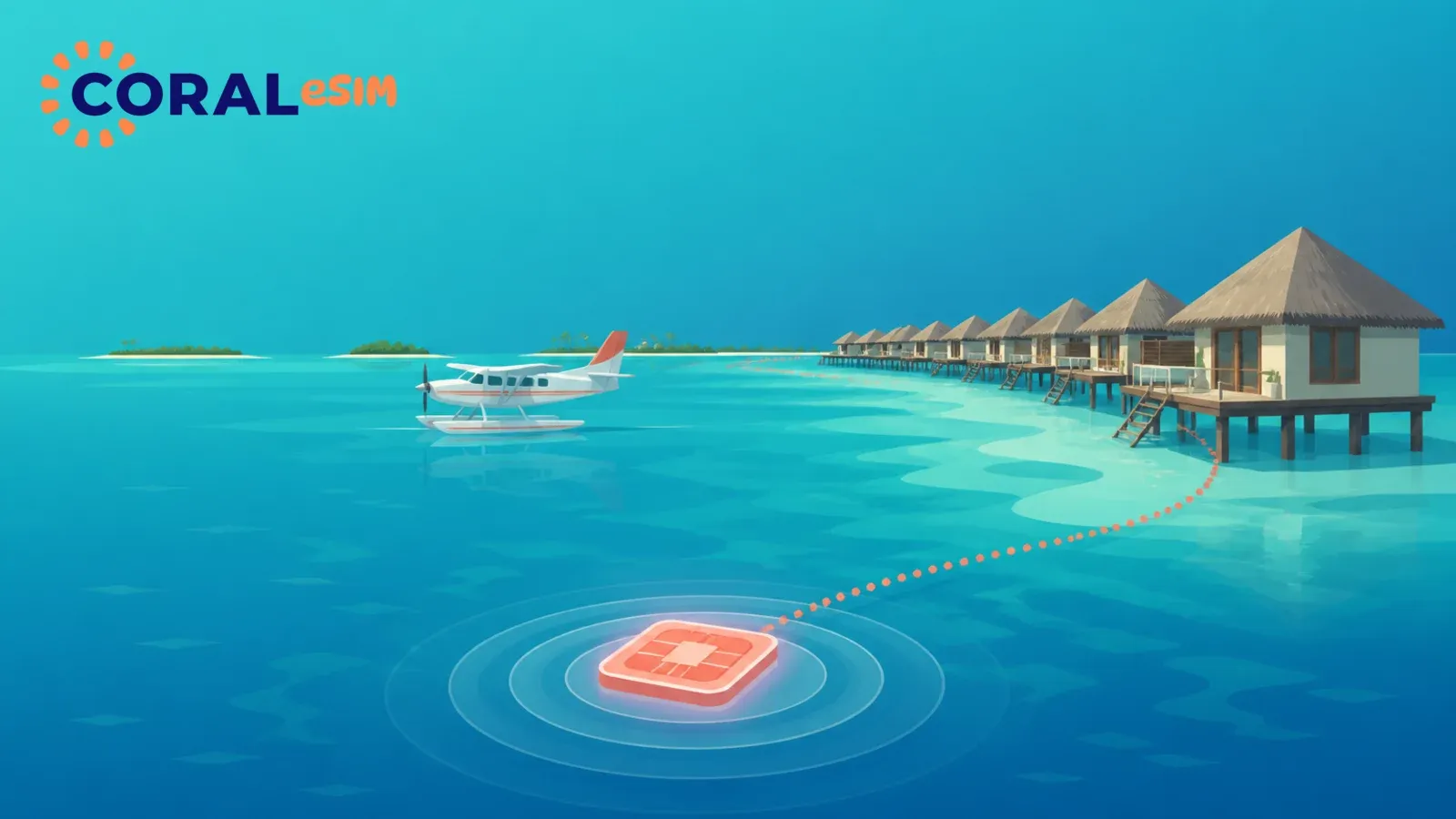
The short answer: an eSIM for the Maldives does not earn its place during your resort stay. It earns it in the hours between landing at Malé and actually reaching your island. That gap holds the IMUGA declaration, immigration, a seaplane that cannot fly after dark, and a stretch of open water with no coverage. Once you are on the island there is Wi-Fi. Getting there is the problem.
So the selection criterion for the Maldives is simple: set it up before you fly, and have it live the moment you land. Match data to your itinerary on the Maldives eSIM plans.
A Maldives eSIM matters most between arrival and your resort
The shape of a Maldives trip is unusual. Your international flight lands at Malé, and for most travellers the destination is an island some distance away. Everything that needs a connection clusters in that joint.
IMUGA is due within 96 hours, and every traveller files separately
According to the official Maldives Immigration portal (IMUGA), every traveller entering the Maldives must submit a Traveller Declaration. The essentials:
- Submit it within 96 hours before your arrival flight's departure time. File too early and it is invalid, so you file again
- It is free. The only official portal is imuga.immigration.gov.mv, and the portal itself warns about sites that charge a fee
- Each traveller files individually, infants included
Submitting produces a confirmation code that immigration may ask to see. Filing for a whole family from a transit airport means depending on that airport's Wi-Fi. Do it before you leave. Rules change, so check the official site close to departure.
Seaplanes do not fly after sunset
This is the Maldives-specific constraint. The Trans Maldivian Airways FAQ states plainly that because these aircraft land on and take off from water, they can only operate from sunrise to sunset. It advises that if you want to reach your resort the same day, plan to arrive in the Maldives by 15:30 local time, and that travellers who cannot make it in time may spend a night in Malé or Hulhumalé instead.
In practice that means arrival day includes either a wait in a lounge or a possible overnight near the airport. TMA notes that depending on your booking you may wait in a resort lounge, one of its own lounges, or the MACL-operated Neeri Lounge. That is exactly when you need to message the resort, arrange a room, or tell people at home what is happening. The 15:30 figure is the operator's guideline and varies by resort and flight.
Treat the transfer itself as a dead zone
Twenty to forty-five minutes by seaplane, or anywhere from half an hour to well over an hour by speedboat. There are no towers out between the atolls. Speedboats hold on longer because they stay nearer land, but plan for both as offline. Send your arrival message before you board, not during.
Networks and eSIM support in the Maldives
There are two operators, Dhiraagu and Ooredoo. Both run 5G around Malé and Hulhumalé, with 4G carrying the atolls. How well a resort island receives depends heavily on which atoll it sits in. An island in South Malé Atoll and one out in Noonu or Lhaviyani are not comparable, which is why a single "the Maldives gets X Mbps" number tells you very little.
Practically: on the land of a resort island you will have either a mobile signal or Wi-Fi. What breaks, again, is the transfer.
Local operator eSIMs and travel eSIMs are not the same route
Comparison articles rarely mention this. The two local operators route you to an eSIM in completely different ways.
Ooredoo: there is a route built for visitors
Ooredoo's official page lists three ways to get a tourist SIM: buy an eSIM and activate it instantly, buy online and collect a physical SIM at the Velana International Airport shop, or enter the number on a blank SIM you already hold and activate instantly. There is both a shop and a self-service kiosk at the airport.
Dhiraagu: the documented route runs through its own app
Dhiraagu's official eSIM page describes downloading the Dhiraagu app, signing in with MyAccount or a mobile OTP, and activating from the "Activate eSIM" banner. Switching from a physical SIM to an eSIM carries a one-time charge. By design this is a route for people who already hold a Dhiraagu line, not something an arriving traveller picks up cold.
A travel eSIM: you can load it before you go
The decisive difference is that a travel eSIM can be bought and installed while you are still at home. No queue at the airport, no signing into a local operator's app. You can check IMUGA and message the resort from the moment you land, which is exactly what the Maldives itinerary demands. The setup flow is in how to set up an eSIM for travel, and plans are on the Maldives eSIM page.
What to do before you leave for the Maldives
The order matters. Work down this list and there is almost nothing left to do on arrival day.
- Confirm your device supports eSIM and is not carrier-locked (checking eSIM device compatibility)
- Install the eSIM at home. Scanning the QR needs a stable connection
- File IMUGA for everyone travelling, within 96 hours of your arrival flight's departure
- Save your transfer details and times somewhere offline, because the transfer has no signal
- Download maps for Malé and your island (how to set up offline maps for travel)
If the line does not come up after landing, work through what to do when your eSIM will not connect on arrival. For the airport-counter alternative, see buying a SIM at the airport versus using an eSIM.
Splitting usage between resort Wi-Fi and your own line
Most of a Maldives trip is spent on one island, with Wi-Fi in the villa and the restaurants. Push the heavy traffic there.
- Upload photos and video, take video calls and stream over the resort Wi-Fi
- Keep your own line for transfer days and anything off the island
- Treat off-island time as unreliable - snorkelling trips, sandbank picnics, uninhabited-island excursions
Split that way, the data you actually need is smaller than most people assume. Your own line also covers you when the villa Wi-Fi is weak, which over-water villas are prone to. For connectivity on the water generally, see using an eSIM on a cruise.
Using resort Wi-Fi safely
Resort Wi-Fi usually comes with a per-villa password, so it is better managed than an open hotspot. It is still a shared network. Do banking and card entry over your own line. The general precautions are in is public Wi-Fi abroad safe, and how to protect yourself.
FAQ
Do eSIMs work in the Maldives?
Yes. The two local operators, Dhiraagu and Ooredoo, both support eSIM. The routes differ: Ooredoo offers visitors instant eSIM activation and airport collection, while Dhiraagu's documented flow runs through its own app and suits people who already hold a Dhiraagu line. If you want connectivity ready before arrival, a travel eSIM bought at home fits the itinerary better.
My resort has Wi-Fi. Do I still need an eSIM for the Maldives?
For the stay itself, resort Wi-Fi largely covers you. The need comes earlier: checking IMUGA after landing at Malé, messaging the resort, waiting for a seaplane, and the possibility of an overnight in Malé or Hulhumalé if you miss the daylight window. None of that is inside the resort's Wi-Fi.
When should I set up my Maldives eSIM?
Before you leave home. Installing an eSIM needs a stable connection, so doing it on arrival means first solving the connectivity problem you bought the eSIM to solve. Install at home and leave only the activation for after you land.
Will I have signal on a seaplane or speedboat transfer?
Assume not. There is open water between the atolls with no coverage, and transfers run twenty to forty-five minutes by seaplane and longer by boat. Send arrival messages before you board. Note also that seaplanes only operate between sunrise and sunset, so a late international arrival can push your transfer to the next morning.
How much data do I need for a Maldives trip?
If you spend most of the trip on one island and push photo uploads and video calls onto the resort Wi-Fi, your own line mainly covers transfer days and off-island excursions, and a modest allowance is enough. If you plan to run everything through your own line instead, size it by the number of days with room to spare.
Choose a Maldives eSIM for getting there, not for the resort
Picking a Maldives eSIM by comparing speeds and allowances misses the point, because once you are on the island there is Wi-Fi. The difference shows up in the sequence before that: the IMUGA declaration due within 96 hours, immigration, a seaplane that only flies in daylight, and a transfer over water with no coverage. Whether you hold your own line through that stretch is what shapes arrival day.
The plan is short. Install the eSIM before you fly, file IMUGA for everyone, and keep your transfer times offline. Then lean on resort Wi-Fi once you are there, and the data you need stays small. Match a plan to your trip on the Maldives eSIM page.
